week two.
What do you think Eskilson is suggesting is the relationship between major world events and design? Give examples.
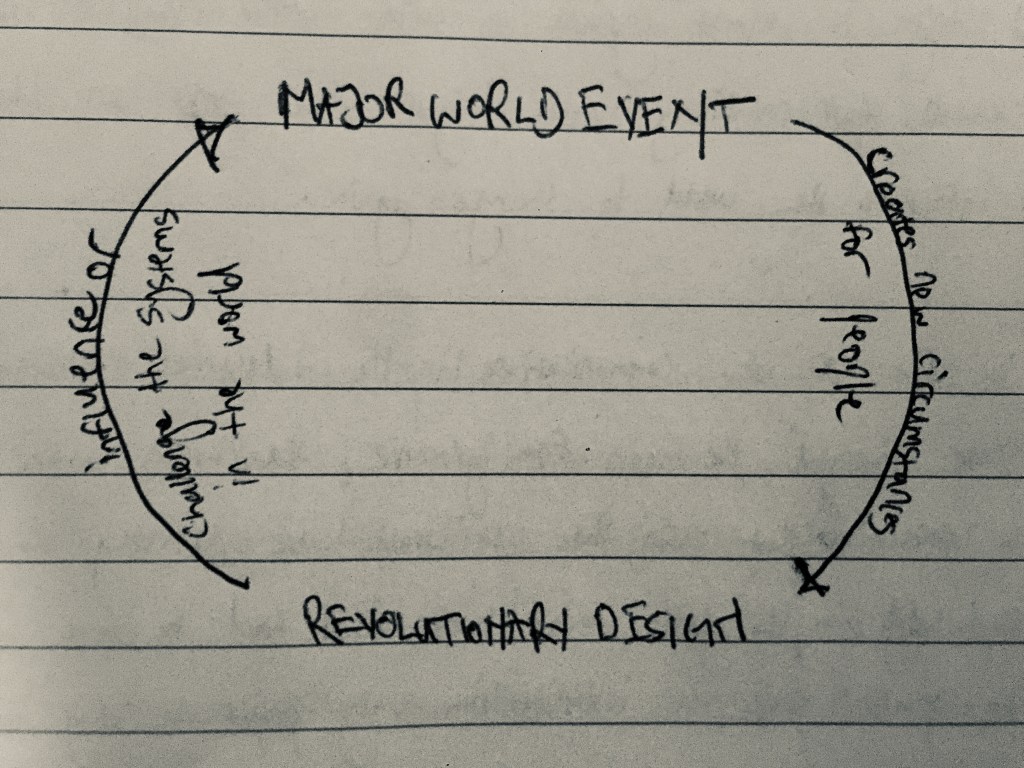
Initially Eskilson seems to imply that design is influenced by world events with the industrial revolution resulting in a change in how society functions in terms of trade, transportation and leisure, but Eskilson goes on to highlight how design has also had an impact on world events with a good example being in the form of satirical newspaper ‘La Caricature’ famously known for its portrayal of French king Louis Philippe which resulted in direct censorship of the French press, the press were no longer allowed to publish caricatures of the king or high ranking officials. Although this had a negative effect it is clear that even something as simple as a drawing can have colossal effects so I have concluded that the relationship between world events and design is somewhat cyclical as major world events can put people in situations where they feel the need to express themselves, those expressions which can go on to influence something greater and so on.
What do you think is the legacy of the rise of new communications?
The rise of new communications in the industrial revolution in a sense liberated the masses from ignorance, that they now had acess to information previously only obtainable by the elite allowed for a greater sense of individualism among people as they now had the means through knowledge to express their tastes and passions.
What are some examples of the changes in design aesthetics and functions?
Changes in typography are very apparent as those used in the past tended to be handwritten thus more freeflowing and decorative. Also the designs that went into posters and the likes emphasized more on delivering as much information as possible in contrast to today where designers are free to focus more on aesthetics.
Why does this all matter now?
I believe this is important in order for design to keep evolving, history in all aspects is important so that people can find inspiration and improve on old methods or techniques while avoiding making mistakes already made in the past.

